Indoor Climbing Plateaus: How to Break Through Your Grade Ceiling in 2026
Stop getting stuck at the same grade. Learn the precise training and movement adjustments needed to break indoor climbing plateaus and start sending harder.
The Psychology of Indoor Climbing Plateaus
You have hit a wall. Not a literal wall, though you are staring at one, but a cognitive and physical ceiling that makes every attempt at a harder grade feel like a lottery. You can send every V3 in the gym, but the V4s feel like a different sport. This is the most common frustration in the gym. Most climbers believe they have reached their natural limit when they actually have just reached the limit of their current movement patterns. You are not weak. You are inefficient. You have spent months practicing the same three movement archetypes and you are trying to apply them to problems that require a completely different set of mechanical solutions. Breaking indoor climbing plateaus requires a violent shift in how you approach the wall. You cannot simply pull harder to get to the next grade. If you try to muscle through a plateau, you will either plateau further or injure a pulley. The solution is to stop climbing for a week and start analyzing how you actually move.
The problem with gym climbing is that the holds are often too good. Large, ergonomic jugs and chunky volumes allow you to compensate for poor footwork by simply pulling harder. You have developed a reliance on your upper body strength because the gym environment rewards it. When you move up a grade, the holds shrink, the angles change, and your reliance on raw power becomes a liability. You are likely gripping too hard, fighting the wall, and wasting energy on movements that should be effortless. To break through, you must stop treating the gym as a place to workout and start treating it as a laboratory for movement. You need to stop climbing things you can already do. If you spend your entire session sending things you already know how to do, you are not improving. You are just maintaining. Growth happens in the zone of failure. If you are not falling, you are not learning.
Most climbers treat their gym sessions as a series of attempts. They try a move, fall, try again, and then move on. This is a mistake. To overcome indoor climbing plateaus, you need to move from a mindset of sending to a mindset of mastery. This means spending ten minutes on a single move, trying it five different ways, and analyzing why one way feels a fraction easier than the others. You need to feel the center of gravity shift in your hips. You need to notice the exact moment your heel slips. When you stop focusing on the top of the route and start focusing on the micro-adjustments of your body, the ceiling begins to lift. The plateau is not a wall. It is a mirror reflecting your technical deficiencies back at you.
Technical Overhauls to Increase Grade Potential
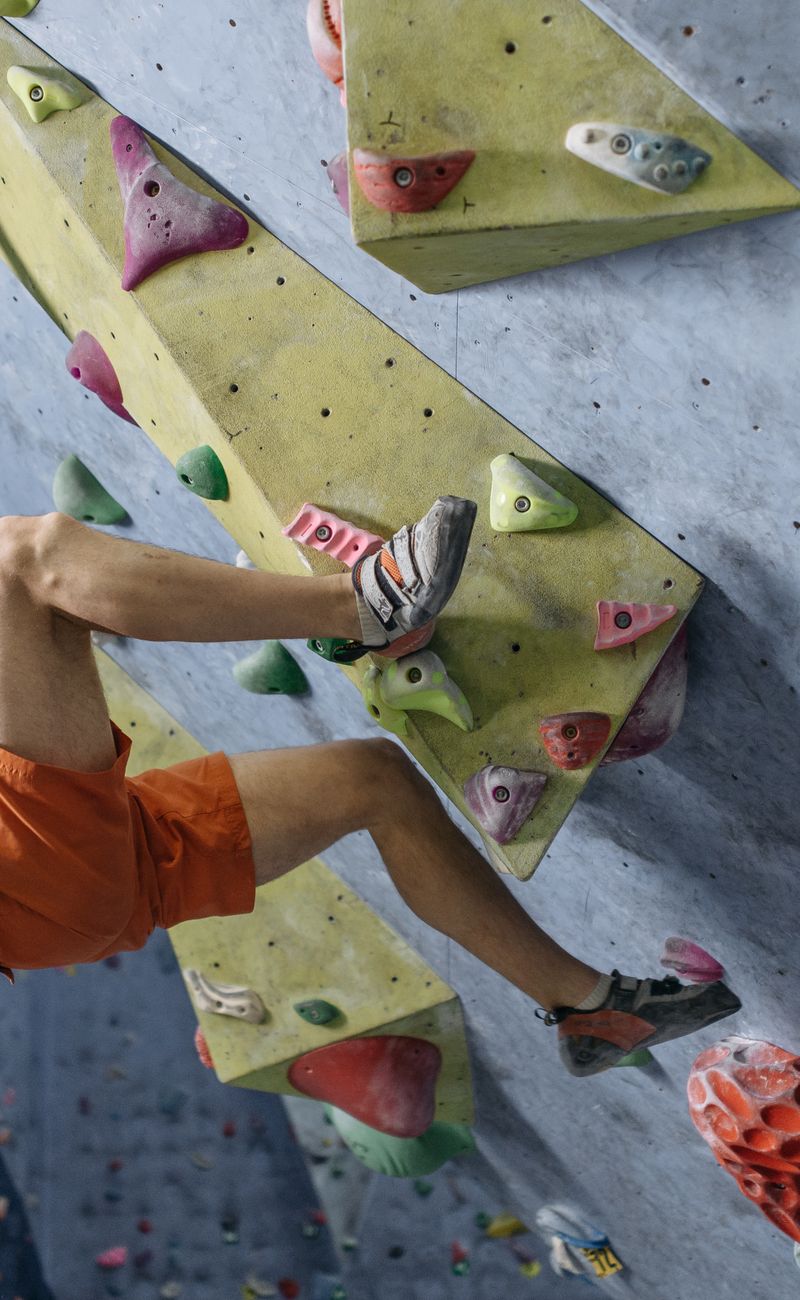
Your feet are likely the reason you are stuck. Most intermediate climbers use their feet as stabilizers rather than drivers. You place your foot on a hold and you hold it there. This is passive climbing. To break indoor climbing plateaus, you must transition to active footwork. This means pushing through the hold to drive your center of mass upward. You should feel the pressure in your toes, not just the contact. If you cannot feel the hold with your toes, you are not using it. This requires a shift in focus. Stop looking at the next hold and start looking at your feet. Many climbers look at the hold they are moving to and forget where their foot is, leading to a sloppy placement that ruins the subsequent move. Precise footwork creates a stable platform, which reduces the load on your fingers. When your feet are working, your hands do not have to work as hard.
Hips are the engine of climbing. If your hips are away from the wall, you are creating a lever that pulls you off the hold. You have likely been taught to keep your hips close, but you are probably not doing it. To fix this, focus on the angle of your pelvis. When you move your hips closer to the wall, you shift your weight over your feet. This is the difference between a V3 climber and a V6 climber. When you are stuck on a move, do not pull harder. Instead, try shifting your hips two inches to the left or right. Try turning your hip into the wall. This changes the vector of force and often makes a hold feel significantly more secure. If you are consistently struggling with overhangs, it is almost certainly a hip problem. You are likely swinging away from the wall, which creates momentum that works against you. Learning to keep your center of gravity tucked in is the fastest way to see a jump in your grade.
Another critical area of failure is the lack of varied grip types. Gyms are filled with crimps and jugs, but they often lack the nuanced holds found in nature or on high level competitions. If you only climb things that feel comfortable, you are limiting your versatility. You need to intentionally seek out the holds you hate. If you hate slopers, spend a whole session on sloper problems. If you struggle with underclings, find every route in the gym that uses them. Breaking indoor climbing plateaus requires you to expand your vocabulary of movement. You cannot expect to climb a V5 if you only know how to use a full crimp. You must learn how to use open hand grips, how to wrap your thumb for stability, and how to use the friction of a volume. The more ways you can hold onto the wall, the fewer things will stop you from reaching the top.
Structured Training Cycles for Maximum Progress
Random climbing is a recipe for a plateau. If you just show up and climb whatever looks fun, you are training for consistency, not improvement. To break indoor climbing plateaus, you need a structured training cycle. This does not mean you need a complex spreadsheet, but you do need a goal for every session. Divide your training into specific blocks. Spend one block on power, where you attempt moves that are physically impossible for you. Spend another block on endurance, where you climb several grades below your limit for long periods without resting. Spend a third block on technique, where you climb easy routes with perfect form, focusing on silence and precision. By diversifying the stimulus, you prevent your body from adapting to a single type of stress, which is exactly how plateaus form.
The most overlooked part of any training cycle is the recovery phase. You do not get stronger while you are climbing. You get stronger while you are sleeping and eating. Many climbers push themselves every single day, thinking that more volume equals more progress. This is a fallacy. Overtraining leads to a plateau because your central nervous system becomes fatigued. You might still have the strength to pull, but your coordination and mental acuity drop. If you find that you are struggling with moves you used to find easy, you are likely overtrained. Implement a deload week every four weeks. During this week, reduce your volume by fifty percent. Do not attempt your project. Focus on easy movement and mobility. You will often find that you come back from a deload week and suddenly send the project that had you stuck for a month. This is because your body finally had the resources to rebuild the tissue you broke down during the training block.
Integrating specific strength training is necessary once your technique is dialed in. You cannot bypass the laws of physics. Some moves simply require a level of finger strength or core tension that you do not currently possess. However, most people jump into hangboarding too early. If you cannot climb a V4, a hangboard will not make you a V5 climber. Focus on climbing specific strength first. Use a system board or a MoonBoard to train raw power. These boards remove the luxury of big holds and force you to apply your strength in a climbing context. When you move to a system board, you are training the specific muscles used in climbing rather than general gym strength. This is the most efficient way to bridge the gap between grades. Combine this with a basic core routine that emphasizes stability rather than flexion. You need a core that can keep your feet on the wall when you are horizontal, not a core that can do a hundred sit ups.
Overcoming the Mental Barrier of Hard Grades
The plateau is often mental. There is a psychological weight to a grade. When you see a V5 tag, your brain tells you that it is significantly harder than a V4. This creates a tension in your body that actually makes the climb harder. You grip too tight, you breathe shallowly, and you move with hesitation. To break indoor climbing plateaus, you must detach yourself from the grade. Stop looking at the tags. Instead, look at the movement. Approach a hard problem as a puzzle to be solved rather than a test of your worth. When you remove the pressure of the grade, you allow yourself to experiment. Experimentation is where the breakthrough happens. If you are terrified of failing, you will never try the unconventional beta that actually works.
Commitment is a skill that can be trained. Many climbers fail on a move not because they lack the strength, but because they lack the conviction. They start the move, feel the instability, and then subconsciously pull back. This hesitation is fatal on hard problems. You must learn to commit fully to a movement, even if it feels risky. In the controlled environment of a gym, the only risk is a fall onto a thick mat. Use this safety to practice total commitment. When you decide to make a move, do it with one hundred percent of your effort and intention. The difference between a failed attempt and a send is often just the level of commitment to the dynamic movement. If you are tentative, you are heavy. If you are committed, you are light.
Finally, stop comparing your progress to the person next to you. Every climber has a different morphology and a different strength profile. Some people are naturally flexible, while others have incredible finger strength. If you spend your time wondering why someone else is progressing faster, you are wasting mental energy that should be spent on your own movement. Focus on your own trajectory. The only metric that matters is whether you are better today than you were a month ago. If you are still stuck, it means you have not yet found the right lever to pull. Keep adjusting your technique, keep refining your training, and keep attacking the wall with a level of aggression that reflects your desire to improve. The plateau is not a permanent state. It is a signal that your current methods have reached their limit and it is time to evolve.