How to Improve Gym Climbing Footwork: Precision and Weight Transfer (2026)
Stop slipping off holds and wasting energy. Master the technical precision of indoor footwork to climb harder grades with less effort.
The Reality of Poor Gym Climbing Footwork
You are probably relying on your arms far too much. Most indoor climbers treat their feet as mere balancing tools rather than the primary engine of movement. If you find yourself fighting for every hold or feeling your forearms pump out halfway through a V4, the problem is rarely your grip strength. The problem is your feet. You are likely slapping your shoes onto holds without precision and failing to shift your center of gravity. When you do not trust your feet, your brain forces your arms to overgrip to compensate for the instability. This is a waste of energy that kills your endurance and limits your ceiling.
Improving your gym climbing footwork requires a shift in how you perceive the wall. You cannot just place a foot on a hold and assume it is secure. You have to actively engage the rubber. Indoor holds are often designed with specific orientations that demand a precise point of contact. If you are slightly off center, you will pivot off the hold the moment you move your weight. This is not a failure of the shoe rubber; it is a failure of your precision. You need to stop treating the climb as a series of pulls and start treating it as a series of pushes. Your legs are significantly stronger than your arms. If you use them correctly, the climb becomes a game of balance rather than a test of raw upper body strength.
Precision starts with the eyes. Most climbers look at the hold, slap their foot in the general vicinity, and then move. This is a recipe for instability. You must watch your foot until it is exactly where it needs to be. This slow, deliberate process feels tedious during a warm up, but it is the only way to build the neuromuscular pathways required for high level climbing. When you focus on how to improve gym climbing footwork, you are essentially training your brain to map the wall with millimeter accuracy. Once this becomes subconscious, you will stop slipping and start moving with a fluid grace that makes hard problems look easy.
Mastering Weight Transfer and Center of Gravity
Placement is only half the battle. Even a perfectly placed foot is useless if your weight is not positioned to utilize it. Weight transfer is the act of moving your center of mass over your point of support. If your foot is on a hold but your hips are shifted three inches to the left, you are creating a lever that pulls you away from the wall. This creates a feeling of instability that you try to fix by gripping harder with your hands. You are fighting physics instead of using it. To fix this, you need to consciously move your hips toward the wall and directly over your feet.
The most common mistake in indoor climbing is keeping the hips square to the wall. While this works on vertical terrain, it is a liability on overhangs. You need to learn how to twist your body. By turning your hip into the wall, you bring your center of mass closer to the rock, which reduces the load on your fingers. This is the secret to climbing steep terrain without burning out. When you shift your hip, you change the angle of the force acting on your foot, allowing you to push more effectively. If you cannot move your hips, you are just hanging from your arms and hoping for the best.
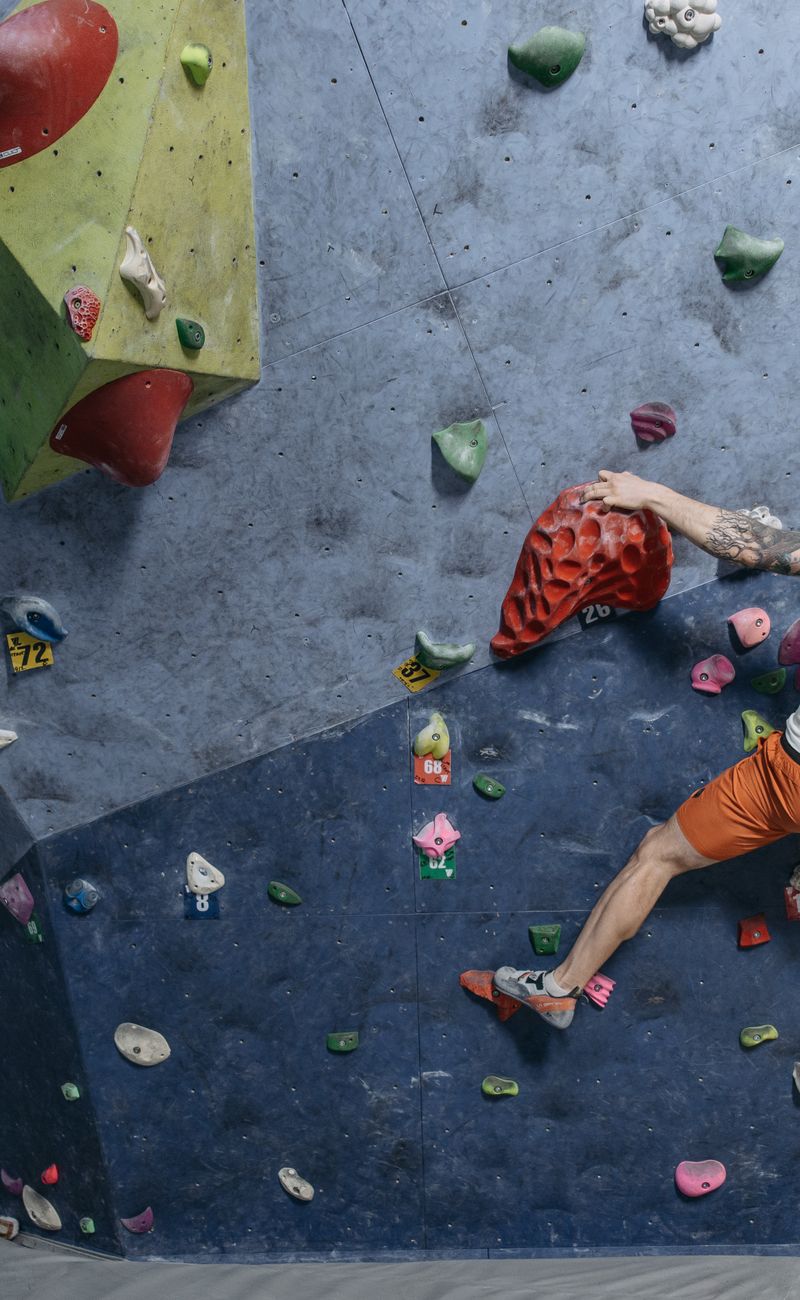
Try to feel the pressure in your big toe. If you do not feel a concentrated point of pressure, you are likely sliding or using too much of the sole. High precision footwork relies on using the smallest possible surface area of the shoe to maximize the force directed into the hold. When you combine this precision with a deliberate shift in your center of gravity, you create a stable platform. This stability allows you to reach for the next hold without the fear of your feet popping. This is how you improve gym climbing footwork from a basic level to an advanced level. It is the difference between clinging to a wall and dancing on it.
The Role of Edging and Smearing in Indoor Environments
Indoor climbing gyms provide a curated experience, but the holds are designed to mimic real rock. This means you need to understand the difference between edging and smearing. Edging is when you use the stiff edge of your shoe to stand on a small lip. Many climbers make the mistake of putting their entire foot on a small edge, which causes the shoe to deform and slip. Instead, you should be loading the very tip of the shoe. This concentrates all your weight on a tiny area, creating maximum friction and stability. If you feel your foot slipping, check if you are standing too far back on the hold.
Smearing is a different beast entirely. It is the act of using the friction of the rubber against a flat surface. In a gym, this often happens on large volumes or the wall itself. The key to a successful smear is surface area and pressure. You want to press as much rubber into the wall as possible while pushing directly downward. If your foot is angled too far up or down, the rubber will slide. Smearing requires a level of trust that many indoor climbers lack. You have to commit to the friction. If you hesitate, you will likely slip. Trusting your smear allows you to maintain balance while moving through sections where there are no distinct footholds.
Integrating these two techniques is where the real progress happens. Many problems require you to transition from a precise edge to a broad smear. If you cannot switch your mental state between these two types of contact, your movement will be clunky. Practice this by intentionally seeking out problems that force you to use both. Focus on the sensation of the rubber. Feel where the shoe is gripping and where it is failing. This tactile feedback is the only way to truly refine your gym climbing footwork. Stop guessing and start feeling the friction.
Developing a Footwork Training Protocol
You cannot improve your footwork by just climbing hard problems. If you only climb at your limit, you will revert to your worst habits because you are in survival mode. To actually evolve, you need to implement a specific training protocol. Start with silent feet. This is a classic drill for a reason. The goal is to place your feet on holds without making any sound. If you hear a slap or a scrape, you have failed. This forces you to be mindful of your placement and requires you to control your descent onto the hold. It strips away the aggression and replaces it with precision.
Next, implement the three point check. Before you move your hand, you must verify that your feet are perfectly positioned and your center of gravity is optimized. Do not move until you are certain that your base is stable. This slows you down significantly, but it breaks the habit of sloppy movement. Once you have mastered this, move into a phase of intentional over-correction. Try to find the absolute worst possible foot position for a move, and then consciously adjust it to the best possible position. Feeling the difference between a bad placement and a good placement is the fastest way to build intuition.
Finally, focus on your foot transitions. Many climbers are great at placing their feet but terrible at moving them. They leave their feet on holds long after those holds have ceased to be useful, which creates tension in the legs and limits reach. Practice the art of the clean foot swap. Move your feet with purpose and timing. Your feet should move in coordination with your hips, not as an afterthought. When you prioritize the lower body in every single move, you will find that the hardest problems in the gym suddenly feel manageable. The secret is not in your fingers; it is in your toes.
Stop ignoring your feet and start treating them as the primary tool for ascension. If you continue to climb with sloppy footwork, you will hit a ceiling that no amount of hangboarding can fix. The only way to break through is to commit to the tedious work of precision and weight transfer. Go back to the easy walls and perfect your movement until it is silent and effortless. That is the only way to actually improve gym climbing footwork and reach the next grade.