Climbing Rope Guide: Choosing, Inspecting, and Retiring Your Lifeline
Your rope is the only piece of gear that stands between you and the ground. Here is how to pick the right one, keep it alive, and know when it is done.
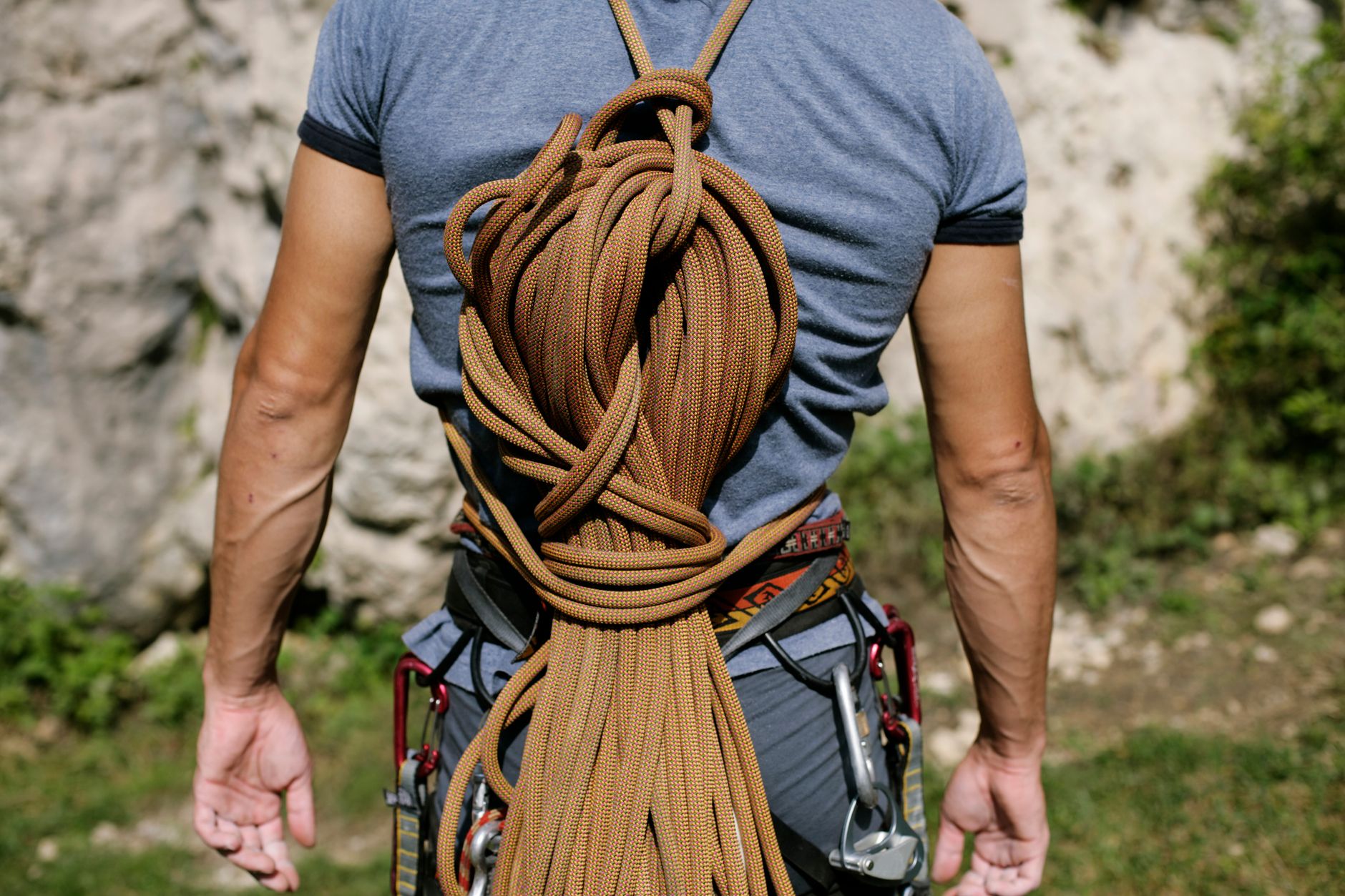
Photo: BOOM Photography / Pexels
Dynamic Ropes: The Only Rope That Matters for Climbing
There are two kinds of ropes in the world: dynamic and static. Static ropes do not stretch. They are for rappelling, hauling, and fixed lines. If you take a leader fall on a static rope, the force on your body and your gear will be catastrophic. Dynamic ropes are designed to stretch under load, absorbing the energy of a fall and reducing the peak force on you, your belayer, and your protection. For climbing, you need a dynamic rope. This is non-negotiable.
Dynamic ropes come in three categories: single, half, and twin. A single rope is exactly what it sounds like: one rope, used alone, rated to hold falls on its own. This is the standard for sport climbing and most single-pitch trad climbing. A half rope is used as a pair, with each rope clipped to alternating pieces of protection. This is the standard for trad climbing on wandering routes where rope drag would be unmanageable with a single line. A twin rope is also used as a pair, but both ropes are clipped through every piece of protection. Twin ropes are for alpine climbing where you need two ropes for long rappels but want the security of redundancy.
For most climbers reading this, the answer is a single rope. If you are sport climbing or climbing single-pitch trad, a single rope in the 9.4 to 10.0 millimeter range will cover almost everything you do. Go thinner if you want less weight and better handling. Go thicker if you want more durability. There is no free lunch. The thinner the rope, the faster it wears out. The thicker the rope, the heavier it is on the sharp end and the stiffer it feeds through a belay device.
Rope diameter matters less than most climbers think. The difference between a 9.4 and a 9.8 is about 20 grams per meter, which is roughly 180 grams over a 60-meter rope. That is a small water bottle. What matters more is the construction. Some skinny ropes handle beautifully and last forever. Some thick ropes are stiff and awkward. Read reviews, talk to climbers who have actually used the specific rope you are considering, and ignore the diameter numbers on their own.
Choosing the Right Rope for Your Climbing
Start with length. A 60-meter rope is the minimum for most sport climbing areas. A 70-meter rope gives you more flexibility and is required for some longer routes. If you climb at areas with 35-meter routes, a 70-meter rope is not optional. It is mandatory. The math is simple: to safely lower a climber from a 35-meter route, you need a rope that is at least 70 meters long, because you need both ends of the rope to reach the ground. A 60-meter rope on a 35-meter route means the climber cannot be lowered to the ground. This kills people every year. Know the route length before you climb. Know your rope length before you leave the car.
Treatment matters. Ropes come with either a dry treatment or no treatment. Dry treatment coats the sheath and sometimes the core to reduce water absorption. If you climb outdoors in any condition other than guaranteed dry desert, get a dry-treated rope. Wet ropes are heavier, handle worse, and freeze into stiff cables in cold conditions. A wet rope also loses some of its dynamic properties, which means it absorbs less energy in a fall. Dry treatment adds cost but the payoff is real.
Consider your belay setup. If you use an assisted braking device like a GriGri, you need a rope that feeds smoothly through it. Some ropes are stiff and catch in the device, making it hard to pay out slack quickly. Other ropes are supple and feed through with almost no resistance. The stiffness of a rope is not just about diameter. It is about the construction, the treatment, and how the sheath interacts with the core. If possible, handle the rope before you buy it, or buy from a retailer with a good return policy.
For gym climbing, you do not need a fancy rope. Gym routes are short, the falls are clean, and the rope takes less abuse. A basic 40-meter single rope is plenty. Save your good rope for outdoors. Gym climbing destroys ropes faster than outdoor climbing because the rope runs over textured walls and plastic holds that act like sandpaper. If you climb in a gym three days a week and outdoors on weekends, have two ropes: a cheap gym rope and a good outdoor rope.
Rope Care: Making Your Rope Last
A climbing rope is a consumable. It will wear out. The goal is to get the maximum safe life out of it by treating it well and recognizing when it is done. Here is how to extend the life of your rope.
Keep it off the ground. Dirt is the enemy of rope life. Grit works its way between the sheath and core, abrading the fibers from the inside out. A rope that looks fine on the outside can be damaged on the inside. When you are at the crag, flake the rope onto a rope bag or tarp, not onto the dirt. When you are not climbing, store the rope in a bag or stuff sack, not loose in the back of your car where it picks up every piece of grit on the floor.
Wash your rope. Yes, you can and should wash your climbing rope. Use lukewarm water and a mild soap, or a dedicated rope wash product. Do not use detergent. Do not use hot water. Hand wash the rope in a tub, running it through your hands to work out the dirt. Rinse thoroughly. Hang it in loose coils in a well-ventilated area out of direct sunlight. Do not put it in a dryer. Do not hang it in the sun. UV radiation degrades nylon. A clean rope lasts longer and handles better.
Avoid chemicals. Battery acid, gasoline, solvents, and other chemicals destroy nylon. Do not store your rope in the trunk of your car next to the spare tire, the emergency kit, or anything that could leak. If your rope comes into contact with any chemical, retire it immediately. There is no way to test whether the chemical has compromised the core. The risk is not worth it.
Keep it away from sharp edges. This sounds obvious but it is worth repeating because it is the number one cause of rope failure. A rope over a sharp edge under load can cut in a single fall. When you are setting up a toprope, check the anchor position and the path the rope takes over the rock. If the rope runs over a sharp edge, pad it with a rope protector, a pack, or move the anchor. There is no safe way to climb on a rope that runs over a sharp edge.
Coil it properly. The butterfly coil is the standard. It keeps the rope from tangling and does not introduce twists. The mountaineer's coil, where you loop the rope over your arm and tie it off, works too. What you should never do is coil a rope by wrapping it around your elbow and hand like an extension cord. This introduces twists that work their way into the sheath and core, making the rope harder to handle and accelerating wear.
When to Retire a Rope
There is no fixed lifespan for a climbing rope. A rope that has never been used and stored properly is safe for years. A rope that has taken multiple hard falls in a single season might need to be retired after a few months. The decision depends on usage, not calendar age. Here are the signs that your rope is done.
Core shots. If you can see the core of the rope through a damaged sheath, the rope is retired. No exceptions. The sheath protects the core, and without it, the core is exposed to abrasion, UV, and chemicals. You cannot repair a core shot. Cut the rope at the damaged section and use the remaining length for something else, or retire the whole thing.
Flat spots. Run the rope through your hands. If you feel a section that is noticeably flatter or softer than the rest, the core may be damaged. A flat spot means the core strands have broken inside the sheath. This is a structural failure. The rope is retired.
Stiff sections. A rope that was supple when new and has developed stiff sections has internal damage or contamination. Stiffness can be caused by core fusion, where the nylon has melted together from excessive heat, or by chemical contamination. Either way, the rope's dynamic properties are compromised. It is done.
Sheath slippage. The sheath should not slide over the core. If you can move the sheath relative to the core, the bond between them has failed. This is rare in modern ropes but it does happen. A rope with sheath slippage can form a bulge where the sheath bunches up and a thin section where it has pulled away. Both are dangerous. Retire it.
Hard falls. Every rope is rated for a number of UIAA falls. This is the number of standardized test falls the rope can hold before breaking. In practice, real climbing falls are less severe than the test falls, so a rope that has taken a few big whippers is probably fine. But if you have taken a fall that was significantly harder than normal, a factor-2 fall or a fall from high above your last piece onto a low anchor, inspect the rope carefully and consider retiring it. The UIAA fall rating is a guideline, not a guarantee.
Age. Most rope manufacturers recommend retiring a rope after ten years regardless of use. This is conservative. A rope that has been stored properly in a cool, dark place and never used is probably fine after ten years. A rope that has been used regularly and stored in a hot car is probably done well before ten years. Use your judgment. If the rope feels different than when it was new, softer, stiffer, fuzzier, or if you cannot remember the last time you inspected it, replace it. The cost of a new rope is nothing compared to the cost of a rope failure.
Your rope is not the place to save money. Buy the right one for your climbing. Take care of it. Inspect it regularly. Replace it when it tells you it is done. A rope is a piece of safety equipment, not a fashion accessory, and treating it like one is the difference between a long climbing career and a short one.