Chalk and Grip: Why Your Hand Prep Matters More Than You Think
Most climbers think grip strength is about fingers. It starts with skin, sweat, and chalk. The complete protocol for hand preparation that makes every hold feel bigger.
You spend hours on the hangboard. You do pull-ups until your lats scream. You project on plastic until your tips bleed. And then you go outside, grab a piece of rock, and slide off a hold you should be able to hold. The problem is not your finger strength. The problem is your grip interface. The contact between your skin and the rock is the most important variable in climbing, and it is the variable that almost every climber neglects. Chalk, skin condition, and hand preparation are not afterthoughts. They are the foundation that determines whether your finger strength can actually be applied to the hold in front of you.
Think about it this way. You can have the strongest grip in the world, but if your hands are sweaty, your skin is torn, or your chalk is clumped into ineffective nuggets, none of that strength transfers to the hold. The coefficient of friction between your skin and the rock is what determines whether a hold feels positive or impossible. A tiny increase in friction, even two or three percent, can be the difference between sticking a crimp and sliding off it. This is not a marginal gain. This is the difference between sending and falling. And it is entirely within your control.
The Physics of Friction: Why Chalk Works and When It Fails
Friction between two surfaces is governed by a straightforward relationship. The force of friction equals the normal force multiplied by the coefficient of friction. In climbing terms, the normal force is how hard you are pressing against the hold, and the coefficient of friction depends on the materials in contact. Dry skin on dry rock has a high coefficient of friction. Sweaty skin on dry rock has a lower coefficient. Sweaty skin on wet rock is nearly zero. Chalk, specifically magnesium carbonate, works by absorbing moisture from your skin and creating a dry, high-friction interface between your fingertips and the hold.
But chalk has limits. It works by absorbing sweat, which means it has a finite capacity. Once the chalk on your hands is saturated with moisture, it stops absorbing and starts acting as a lubricant layer between your skin and the rock. This is why over-chalking is as bad as under-chalking. A thick layer of chalk on your hands reduces the direct contact between your skin and the hold, which reduces friction even though your hands feel dry. The ideal state is a thin, even coat of chalk that absorbs just enough moisture to keep your skin dry without creating a barrier between your fingertips and the rock.
Temperature and humidity are the two environmental variables that most affect grip performance. In hot, humid conditions, sweat production increases dramatically and chalk saturation happens faster. In cold, dry conditions, your skin can become too dry and crack, which also reduces friction. The optimal temperature for maximum grip is between 50 and 65 degrees Fahrenheit with low humidity. Below 40 degrees, your skin loses elasticity and your fingers feel numb. Above 75 degrees with high humidity, chalk becomes nearly ineffective after a few moves. Understanding these conditions and adjusting your hand preparation accordingly is the difference between a good day and a frustrating day.
Skin Care: The Foundation of Grip That Nobody Teaches
The condition of your skin is the single most undervalued variable in climbing performance. Split tips, flappers, and raw fingertips do not just hurt. They reduce the surface area of your grip contact and lower the coefficient of friction between your skin and the hold. A split tip on your index finger reduces your crimping power by a measurable percentage because you are subconsciously avoiding pressure on the wound, which changes your grip position and reduces contact area.
The skin care protocol starts before you climb. File your calluses regularly with a fine-grit sandboard or pumice stone. The goal is not to remove calluses entirely. Calluses are protective. The goal is to keep them flat and smooth so they do not catch on holds and rip off. A raised callus is a future flapper. File it down until it is flush with the surrounding skin. Pay special attention to the base of your fingers where calluses tend to build up the most. This is the area most likely to tear on crimp moves.
After climbing, wash your hands with soap and water to remove chalk residue, which dries out the skin. Apply a climbing-specific hand balm or a simple unscented moisturizer. Avoid products with petroleum jelly or heavy oils, which leave a residue that reduces friction the next day. The goal is hydrated, elastic skin, not soft skin. Well-hydrated skin stretches under pressure instead of tearing. Dry, cracked skin splits. The difference between sending your project and walking away with bloody tips often comes down to whether you moisturized the night before.
For multi-day climbing trips, the protocol is even more important. After each session, wash, moisturize, and let your skin recover overnight. If you have a project session the next day, do not use heavy moisturizer the morning of. Apply it the night before so it has time to absorb completely. On the day of the project, your skin should feel smooth and slightly tacky, not slick. This is the optimal friction state.
Chalk Technique: How to Chalk, When to Chalk, and What Chalk to Use
Not all chalk is equal. Loose chalk, which is pure magnesium carbonate ground into a fine powder, provides the best friction because it coats evenly and absorbs moisture effectively. Block chalk is compressed loose chalk that you crumble into your bag. It lasts longer and creates less dust, but the friction is marginally lower because the particle size is less consistent. Liquid chalk, which is magnesium carbonate suspended in an alcohol base, provides an excellent base layer because it coats every contour of your fingertips. It dries in seconds and creates a thin, even chalk layer that lasts for several moves before you need to rechalk from your bag.
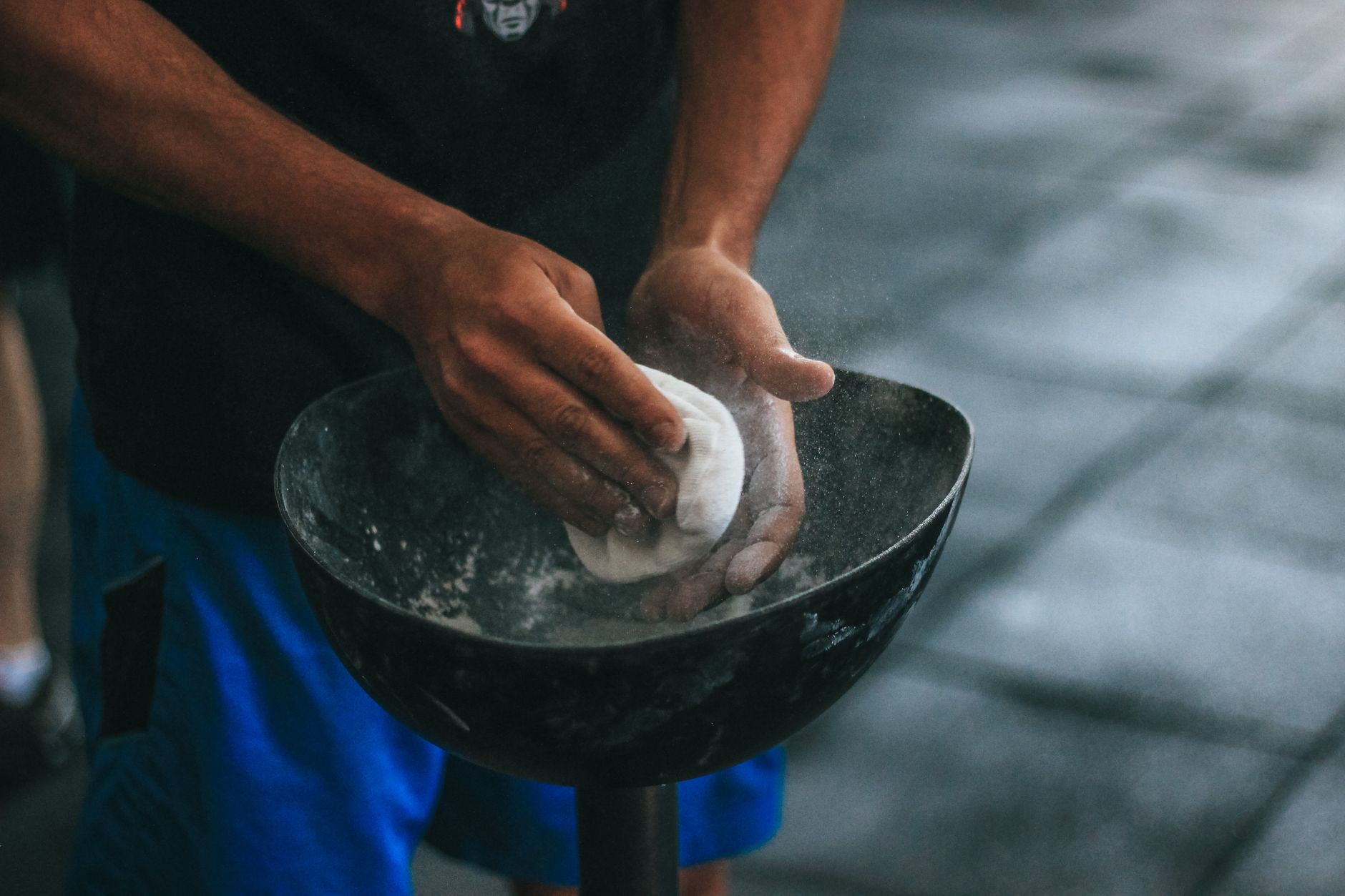
The optimal chalking protocol for maximum friction is a two-layer system. Before you leave the ground, apply liquid chalk to both hands and let it dry completely. This creates your base layer. Then, before each hard section of the route, reach into your chalk bag and apply a thin layer of loose chalk over the liquid chalk base. The liquid chalk provides the foundation. The loose chalk provides the fresh friction surface. This two-layer system gives you significantly better grip than either method alone, especially on long routes where sweat accumulates over time.
When you chalk from your bag, do not just dip your hand in and grab a clump. Rub the chalk between your fingertips and the hold-side of your fingers. Make sure the contact areas, the tips and first pads of your index, middle, and ring fingers, are fully coated. Pay attention to the inside edge of your thumb pad, which is critical for pinches. Chalk the areas that touch holds, not the backs of your hands or your palms, which do not contact the rock. Less chalk in the right places is better than more chalk in the wrong places.
The Complete Hand Prep Protocol
Here is the entire protocol from start to finish. The night before a climbing session, file your calluses flat and apply a thin layer of moisturizer. In the morning, wash your hands with warm water to remove any residual moisturizer. Your skin should feel smooth and slightly tacky, not slippery. Before leaving the ground, apply liquid chalk to both hands and let it dry for 30 seconds. Before each crux or hard sequence, apply a thin layer of loose chalk to your fingertips, focusing on the contact areas. Between attempts, brush the holds if possible to remove your own chalk buildup, which reduces friction for the next try. After the session, wash your hands, inspect for damage, and moisturize again.
This protocol will not add a single pound to your hangboard max. It will not increase your pull-up count. What it will do is ensure that every ounce of finger strength you have actually transfers to the hold. The difference between slipping off a crimp and sticking it is often a matter of two or three percent friction. That is the margin that chalk, skin care, and proper hand preparation provide. The strongest climber with sweaty hands and torn skin will fall off holds that a weaker climber with dialed hand prep will stick. Grip is not just about strength. It is about the interface. Dial the interface, and every hold on the wall gets a little bit bigger.