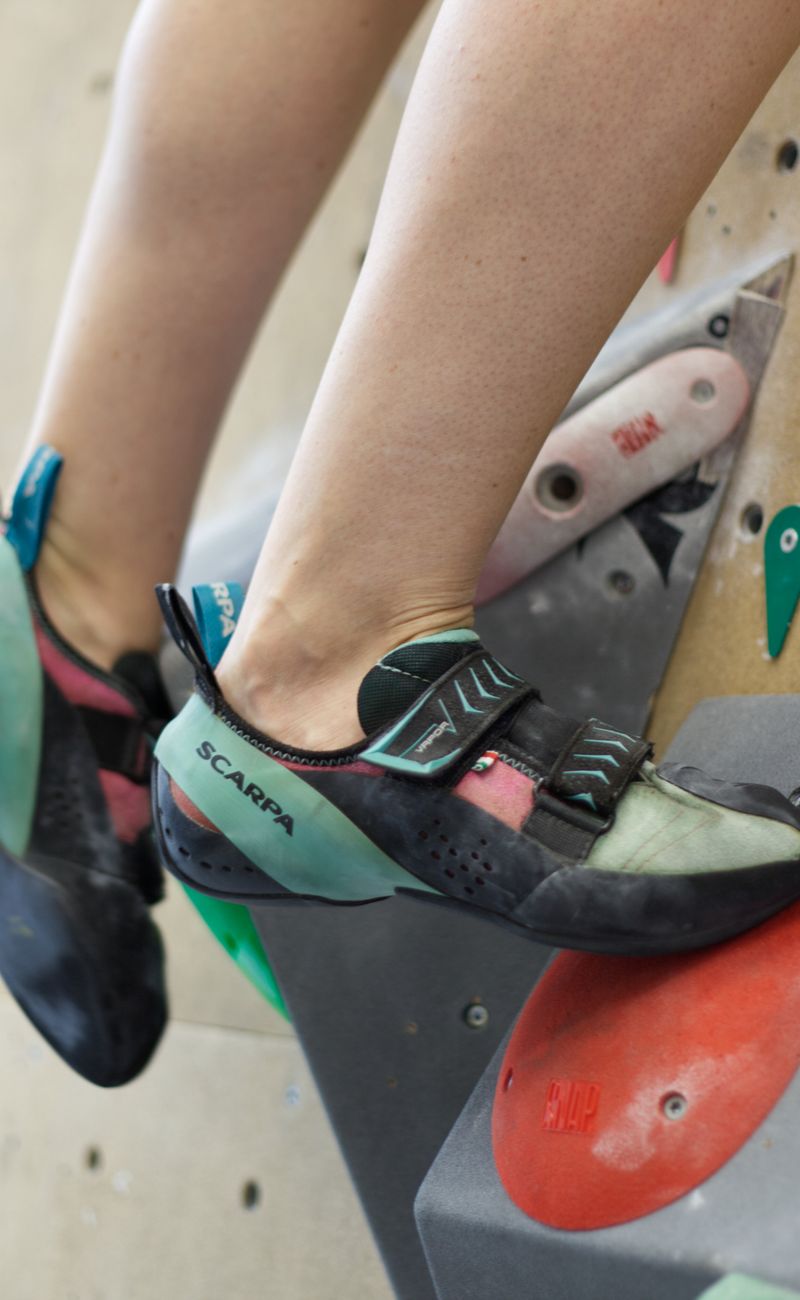
Best Climbing Shoes for Beginners 2026: How to Choose Your First Pair
Stop wasting money on shoes that hurt for no reason. Learn how to select the best climbing shoes for beginners to maximize progression and footwork.
The Lie About Pain and Climbing Shoe Fit
Every beginner climber enters a shop and is told that their shoes should hurt. They are told that toes should be curled into a ball and that blisters are a rite of passage. This is a lie. While a snug fit is required for precision, actual pain is a performance killer. If you are distracted by a hot spot on your heel or a pinching toe, you are not focusing on your weight distribution. You are not focusing on the edge of the hold. You are focusing on how much you want to take your shoes off. The best climbing shoes for beginners are those that provide a secure hold without causing you to bail on a session early because your feet are screaming.
Precision comes from a tight fit, not a painful one. You want your toes to be slightly curved, but not crushed. If you cannot keep the shoe on for twenty minutes of climbing, the shoe is too small. Many newcomers buy aggressive, downturned shoes because they look like what the pros wear. This is a mistake. An aggressive shoe is a specialized tool for steep overhangs. For a beginner, a flat or slightly downturned shoe is the correct choice. It allows you to stand on small edges without your calves cramping and it teaches you how to actually use your feet instead of relying on upper body strength to pull your weight off a poorly fitting shoe.
When you are shopping, ignore the brand hype. Focus on the shape of your foot. Some brands are narrow, others are wide. If you have a wide forefoot and you force it into a narrow shoe, you will develop blisters and lose power. A shoe that fits your natural anatomy allows you to apply more pressure to the hold. This is the foundation of footwork. If your foot is sliding because the shoe is too big, or if you cannot feel the rock because the shoe is too thick, you are fighting your gear instead of the climb.
Understanding Rubber Compounds and Sole Stiffness
Not all rubber is created equal. Some is hard and durable, designed to last through hundreds of feet of slab climbing. Other rubber is soft and sticky, designed to smear against a featureless wall. For those looking for the best climbing shoes for beginners, a medium stiffness is the gold standard. A sole that is too soft will collapse under your weight when you are standing on a tiny edge, causing your foot to pop. A sole that is too stiff will feel like a wooden plank, preventing you from feeling the texture of the hold.
The rubber compound determines how well you can smear. Smearing is the act of pressing the flat part of your shoe against the wall to create friction. If the rubber is too hard, you will slide off. If you are climbing indoors on plastic, you can get away with slightly harder rubber because the holds are designed to be gripped. However, if you plan to transition to real rock, you need a compound that bites into the stone. Most entry level shoes use a versatile rubber that balances durability with grip, which is exactly what you need while you are still learning how to place your feet accurately.
Durability is a major factor for new climbers. Your footwork will be sloppy at first. You will drag your toes against the wall, you will scrape your soles on the ground, and you will essentially sand down your rubber through inefficiency. Do not buy the most expensive, softest rubber on the market for your first pair. You will burn through them in a month. Look for a shoe with a decent rubber thickness that can withstand the learning curve. Once your footwork becomes precise and you stop dragging your toes, you can move toward softer, more specialized rubber.
Flat vs Downturned Geometry for Progression
The shape of the shoe is called the last. A flat last is a shoe that follows the natural profile of the foot. A downturned last is curved like a claw. Beginners often think a downturned shoe will make them better at steep climbing, but the opposite is true. If you do not have the toe strength or the technique to use a downturned shoe, it will actually hinder your progress. You will find yourself unable to stand comfortably on flat ledges, and your calf muscles will fatigue faster because the shoe is forcing your foot into an unnatural position.
p>The best climbing shoes for beginners usually feature a neutral or slightly asymmetric shape. An asymmetric shoe is shaped to put more pressure on the big toe, which is where most of your power comes from during a precise step. This gives you the benefits of a technical shoe without the discomfort of a full downturn. It allows you to transition from vertical walls to slight overhangs without needing a second pair of shoes. If you can only afford one pair, a neutral shoe with a slight asymmetry is the only logical choice.As you progress, you will realize that different styles of climbing require different shapes. Slab climbing requires a flat, stiff shoe that supports the arch. Steep bouldering requires a downturned shoe that hooks into holds. But you cannot learn to use a specialized tool before you understand the basics. Learning to balance on a flat shoe forces you to be more precise with your center of gravity. If you rely on the mechanical advantage of a downturned shoe too early, you will develop bad habits and a reliance on gear rather than technique.
How to Maintain Your Gear for Longevity
Once you find the best climbing shoes for beginners, you need to stop treating them like old sneakers. Rubber is a chemical compound that reacts to temperature and environment. If you leave your shoes in a hot car, the rubber can soften or even degrade. If you leave them in a damp gym bag for three days, the interior lining will rot and the shoes will smell like a swamp. This is not just about hygiene; it is about the structural integrity of the shoe.
Clean your shoes. This sounds simple, but most climbers ignore it. When rubber gets dusty, it loses its friction. If you are slipping off holds that you know you can stick, look at your soles. A quick wipe with a damp cloth or a brush can restore the grip. Furthermore, keep your laces tight. A loose shoe is a useless shoe. The goal is for the shoe to become an extension of your foot. If there is any gap between your heel and the back of the shoe, you will experience heel slip, which makes heel hooks impossible and makes you feel unstable on the wall.
Eventually, you will wear through the rubber. You will see a hole appear in the toe, or the rubber will become so thin that you can feel the inner sole. Do not throw the shoes away. Many local shops offer resoling services. Resoling is the process of replacing the worn rubber with a fresh layer. This is not only cheaper than buying new shoes, but it also allows you to keep a shoe that is already perfectly broken in to your foot shape. Just be aware that some entry level shoes are glued in a way that makes resoling difficult, so check the construction before you buy.
Your gear should support your growth, not dictate it. Stop chasing the aesthetic of a pro climber and start chasing the feeling of a secure, stable platform under your feet. The right shoe is the one that disappears when you start climbing, allowing you to focus entirely on the movement and the rock. If you are still thinking about your feet while you are mid wall, your gear is failing you. Find a fit that works, maintain the rubber, and stop listening to people who tell you that pain is a requirement for progress.