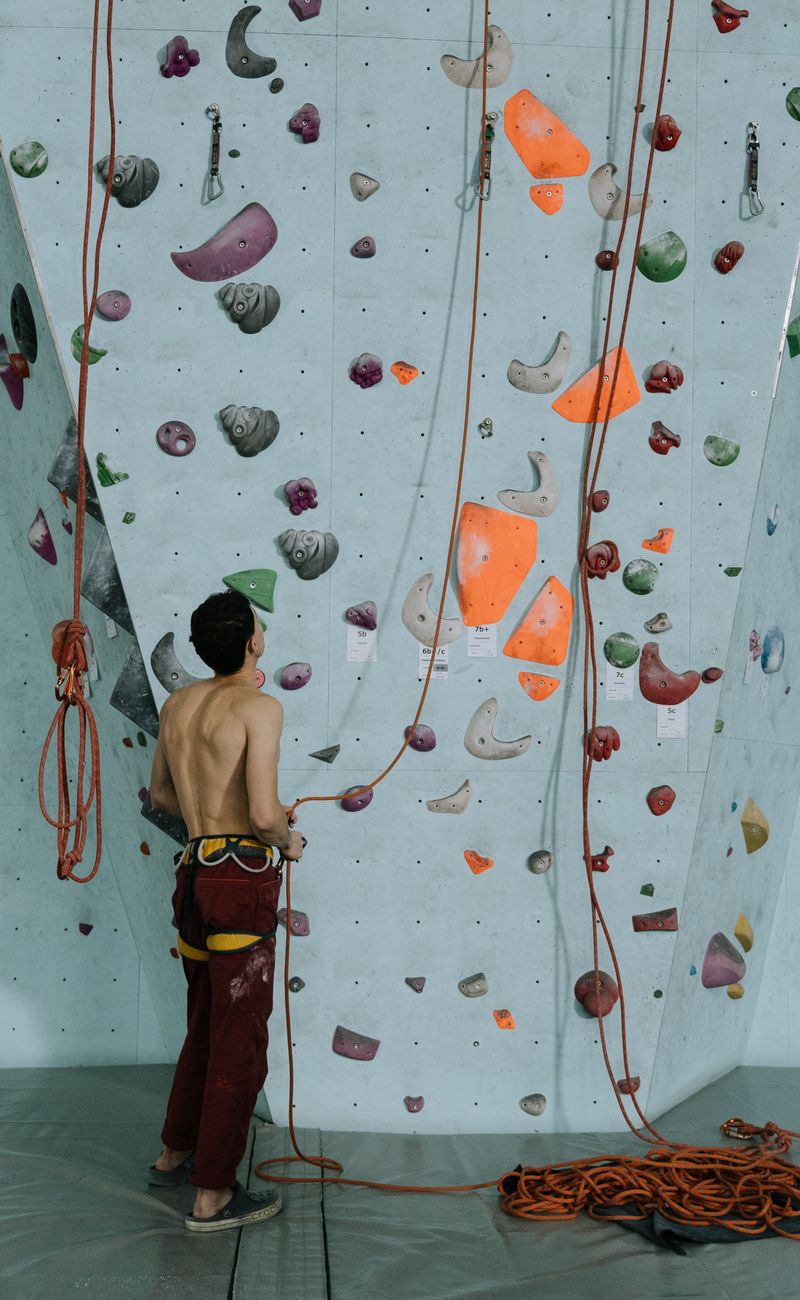
Fear of Falling: The Progressive Protocol for Committing Above Your Gear
Fear of falling is not a weakness. Unmanaged fear of falling is. The progressive protocol for learning to commit to moves above your gear, from practice falls to full sends.

Every climber who has ever pushed their limits knows the feeling. You are three bolts above your last clip, staring at a move that requires full commitment. Your hands are sweating. Your feet are vibrating on holds that feel smaller every second. Your mind is screaming that you cannot fall here. You hesitate, and in that hesitation, the move is gone. You downclimb to the bolt, rest on the rope, and tell yourself you will commit next time. But next time is the same. The fear of falling above your gear is the single most common limiter in sport climbing, and it is not a problem you can think your way out of. It is a physiological response that has to be trained, progressively and deliberately, the same way you train finger strength or power.
The fear of falling is not irrational. Your brain is correctly identifying that falling is dangerous. What is irrational is the degree of the response. A ten-foot fall onto a well-placed bolt with a proper belay is survivable. It is uncomfortable, but it is not dangerous. Your brain does not distinguish between a ten-foot sport fall and a fifty-foot ground fall, though. It treats all falls above gear as equally threatening. This is the gap you need to close: between the actual risk, which is manageable with proper systems, and the perceived risk, which is disproportionate and paralyzing. The way to close this gap is not through positive self-talk. It is through progressive exposure to controlled falls.
Understanding the Fear Response in Climbing
When you climb above your gear and feel the fear response, your amygdala has detected a threat and activated your sympathetic nervous system. Your heart rate increases. Your breathing becomes shallow and rapid. Your pupils dilate. Your grip strength actually increases, but your fine motor control decreases. Your ability to execute precise footwork, which is the foundation of good climbing movement, degrades significantly under sympathetic activation. This is why you feel like you cannot hold on. It is not that the holds are too small. It is that your nervous system is running a threat response that makes precise movement nearly impossible.
The key insight is that this response is not a character flaw. It is a survival mechanism that has kept the human species alive for hundreds of thousands of years. Your brain does not know that you are on a bolted sport route with a competent belayer. It knows that you are high off the ground, your feet are on small holds, and your hands are starting to sweat. From the brain's perspective, this is an emergency. The only way to convince the brain that this is not an emergency is through repeated, controlled exposure to the stimulus, with consistent outcomes that prove safety. Each time you take a clean fall and land softly on the rope, your brain updates its model of the situation. Each time you avoid the fall by downclimbing or grabbing a draw, your brain reinforces the model that falling is dangerous. You are training your fear response whether you intend to or not. The question is whether you are training it toward or away from commitment.
The Progressive Fall Protocol: From Terrified to Committed
This is not a protocol you can rush. Each phase must be repeated until the fear response diminishes before you advance to the next level. If you skip phases, the fear will return at the higher level and you will regress. The protocol has five phases.
Phase 1: Top Rope Falls. Find a route you have already sent that is well within your ability. Climb to the top on top rope. Let go. Fall on the rope. Do this ten times in a single session. The goal is to feel the sensation of falling and being caught by the rope repeatedly until it becomes boring. Most climbers skip this phase because it feels unnecessary. It is not. Your brain needs a baseline experience of falling safely before it can process higher falls. If you cannot fall on top rope without a spike of fear, you are not ready for lead falls.
Phase 2: Controlled Lead Falls at the Bolt. Lead a well-bolted route well within your ability. Climb to the second bolt. Clip it. Have your belayer take in the slack so there is minimal fall potential. Tell your belayer you are going to let go. Let go. Take a controlled two-foot fall onto a bolt you just clipped. Repeat five times. Then climb to the third bolt, clip it, and take a slightly longer fall. Repeat at each bolt until you can let go from the bolt without a spike in heart rate. This phase teaches your brain that falling from above a bolt results in a short, controlled stop.
Phase 3: Falls Between Bolts. This is where most climbers stall. Lead a well-bolted route within your ability. Climb three to four feet above the last bolt and let go. This produces a fall of roughly twice the distance between you and the bolt, plus rope stretch. It feels significantly scarier than Phase 2, even though the actual risk is still very low on well-bolted terrain with a competent belayer. Repeat this until you can take the fall without hesitation. This is the critical phase. If you can take a clean fall from above a bolt and immediately get back on the wall, you have broken the primary barrier.
Phase 4: Whippers. A whipper is a longer fall, typically ten to fifteen feet, that occurs when you are climbing well above your last bolt. To practice whippers safely, choose an overhanging route with clean falls and no ledges. Climb five to eight feet above your last bolt and deliberately let go. The fall will feel dramatic. Your stomach will drop. You will swing. But on an overhanging route with a good belayer, you will not hit anything. Take five to ten whippers in a session until the sensation normalizes. This is the level that most climbers never reach, and it is the level that unlocks the ability to commit to hard moves at your limit.
Phase 5: Committing on Your Project. After you have normalized falls in Phases 1 through 4, you are ready to commit on your project. The project is different because the moves are at your limit, not well within your ability. The holds are smaller. The feet are less secure. The fear response will return, but it will be proportionate to the actual risk rather than disproportionate. You will still feel fear, but you will be able to act through it because your brain has a library of safe fall experiences to draw from. This is the goal: not to eliminate fear, but to make it manageable enough that it does not override your ability to execute.
Belayer Communication: The Safety Net That Makes It Possible
Your belayer is the most important variable in this entire protocol. A bad belayer makes falling dangerous. A good belayer makes it safe. Before you practice any fall protocol, you and your belayer need to have explicit communication. Tell your belayer exactly what you are practicing. Tell them how far above the bolt you plan to be when you fall. Tell them whether you want a soft catch, which means the belayer jumps slightly upward as you fall to reduce the peak force, or a standard catch. Agree on a verbal command for falling. "Falling" is the standard. Say it loudly. Do not say "watch me" when you mean "I am about to fall." Ambiguity in belay communication is dangerous.
A soft catch is essential for practice falls, especially on vertical terrain. When the belayer jumps up as the rope comes taut, the peak force on your body is significantly reduced. This means less jarring on your lower back, less chance of a rope burn, and a much more comfortable overall experience. The goal of fall practice is to accumulate positive experiences with falling. If every fall hurts or feels dangerous, your brain will learn to avoid falls, not accept them. A good belayer who gives consistent, soft catches is the foundation of the entire protocol.
The fear of falling is the gatekeeper between climbing at your limit and climbing below it. Every climber who sends at their limit has learned to commit to moves above their gear. This is not a talent you are born with. It is a skill you develop through deliberate, progressive practice. Start with top rope falls. Progress through bolt falls and whippers. Communicate with your belayer. Take the falls. Let your brain learn that the rope catches you. The moves on your project are not too hard. The fear is just too loud. Turn the volume down, and the sends will follow.