Outdoor Rock Climbing Knots: Essential Tied for Safe Climbs (2026)
Master the essential outdoor rock climbing knots every climber must know. From the figure-eight to the clove hitch, learn when and how to tie each knot for maximum safety and efficiency at the crag.
Your Knot Knowledge Is Your Life Insurance
If you climb outdoors, the rope connecting you to your partner runs through knots you tied with your own hands. That is the reality of this sport. No amount of shiny hardware, carbon fiber shoes, or expensive cam placements matters if your knot fails. The rope does not care about your tick list. It cares about your knot. Climbers have died from failing to tie the proper knot or tying it incorrectly. Not in remote situations with no options. In straightforward scenarios where a single properly tied figure eight would have ended the day safely. This is not fear mongering. It is the reason you train your hands to tie knots until the motion is automatic, until your fingers could tie them blind in cold wind at the base of a multi-pitch route after an hour of approach beta.
Outdoor climbing demands knot competency that indoor climbing does not require. In the gym, your partner checks your knot. The wall is below you. The route is marked and maintained. Outdoors you are responsible for your own knots in real conditions. Wind, cold, wet rope, low light, physical exhaustion, and the mental fatigue of sustained focus all degrade the execution of complex motor patterns. The only countermeasure is overlearning. Drilling your knots until they live in your muscle memory, not your conscious thought. This article covers the essential knots for outdoor climbing and the technical knowledge that separates competent trad climbers from accidents waiting to happen.
The Figure 8 Follow-Through: Your Primary Connection
The figure 8 follow-through is the standard tie-in knot for outdoor rock climbing. There is no acceptable alternative. When you tie into the sharp end of the rope, this is the knot you use. Full stop. The figure 8 distributes load more evenly than an overhand knot, it is easier to inspect under tension, and it resets cleanly after a fall. When you tie a figure 8 follow-through, you create a loop of rope that passes through your harness tie-in points and then the free end retraces the figure 8 pattern for at least six inches of tail. That tail length matters. Too short and the knot can work loose under repeated loading. Too long and it becomes rope drag on multi-pitch routes. Six inches is the minimum. Some climbers tie longer because they have been burned by tails that seemed long enough but werent.
The mechanics matter here. When you dress the figure 8 before loading, ensure the rope lies flat without twists. A twisted figure 8 can cross-load and weaken significantly. After dressing, pass the standing part through your tie-in points, trace back along the standing part to form the follow-through, and dress again before tightening. Do not skip the second dressing. The first pass creates the shape. The second pass aligns the rope parallel, which distributes force correctly and makes inspection easier. When you inspect your partners figure 8, you should see two parallel strands running through the knot, no crosses, no jumps, and a tail length you can verify by eye. If the tail disappears into the knot, you call them back and make them retie. There is no such thing as being too careful with your tie-in.
The Clove Hitch: Adjusting Position Without Re-Tying
The clove hitch is the outdoor climbers best friend for managing position on anchors. It ties quickly, adjusts without untying, and holds securely when loaded. When you arrive at a hanging anchor or a stance where you need to position yourself precisely, a clove hitch on your tether or direct attachment to the anchor gives you the flexibility to move without untying from the system. The hitch goes over the carabiner gate and bites down on itself. Two loops, one bites over the other, and when you clip the bight through the anchor, it seats itself and becomes self-locking. This is not a knot you tie and forget. It is a dynamic tool for position management.
Common clove hitch errors come from improper orientation or insufficient dress. If you tie a clove hitch and load it and it rolls or slips, it is usually because the loops were not dressed cleanly or you tied it on a rounded object where the geometry does not allow the hitch to seat properly. The classic test is to tie it on a carabiner, load it, and see if it holds. If it slips, adjust your loop size and try again. Most slipping clove hitches result from the loops being too large or not wrapping tightly enough around the object. Practice tying it one-handed. Practice tying it in cold conditions. Practice tying it when you are tired and your fingers are stiff. The clove hitch should be as automatic as breathing by the time you climb beyond easy terrain.
The Munter Hitch: Emergency Belay and Versatile Backup
Every outdoor climber should carry a munter hitch in their kit of techniques even if they normally belay with a belay device. The munter hitch converts rope to harness into a friction brake using a single locker. It works bidirectionally, meaning you can lower or belay with the same hitch. It is slower and generates more rope wear than a tube device, but when you need to improvise a belay with limited gear, the munter is there. On multi-pitch routes where you might need to belay your second from the anchor, the munter hitch offers simplicity and reliability that mechanical devices cannot match.
However, the munter hitch has a specific failure mode you must understand. It twists the rope. After multiple cycles of belaying and lowering with a munter, the rope accumulates twist. This causes the rope to want to twist back on itself, creating kinks and loops that make the rope difficult to manage and potentially unsafe. If you use a munter for extended belaying, you need to manage the rope twist by allowing the rope to un-twist periodically. You can do this by pulling the rope through in a controlled manner and letting it unwind, or by using a technique where you feed and take in alternating directions to distribute the twist. When you switch back to a normal belay device, inspect the rope for tight kinks. A rope with accumulated twist damage is a rope you replace. The munter is an emergency tool. Know its limitations.
Munter Hitch Technique and Proper Carabiner Orientation
The munter hitch ties through a locking carabiner with the rope crossing in a specific orientation. You form a loop, pass it over the spine of the carabiner, and tuck it under the crossing point. The resulting configuration allows you to control the rope by applying friction against the carabiner. When you pull up on the dead end, the hitch bites down. When you pull down on the live end, it releases. The orientation matters. If you tie it incorrectly, the hitch can lock up and become difficult to release under load. This is a known issue with the munter hitch. Some instructors teach an offset munter or modified hitch to reduce the likelihood of locking. Whatever version you learn, practice releasing it under load in a controlled environment before you need that skill at a hanging belay.
The Autoblock and Prusik: Your Friction Hitch System for Safety
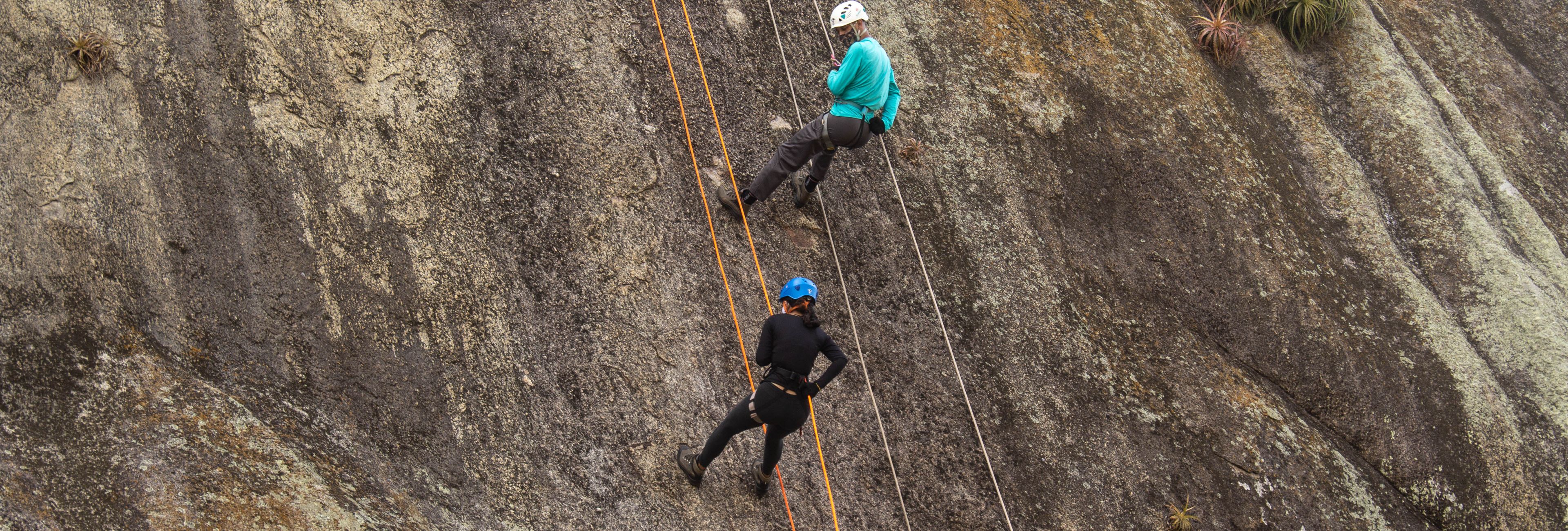
Any outdoor climber who rappel needs a backup friction hitch system. The autoblock is a sliding hitch tied on a cordelette or accessory cord that grabs the rappel rope automatically if you lose control. You tie it as a girth hitch around the rappel rope with the cord, leaving a loop that you clip to your belay loop. When the rappel rope goes slack, the autoblock seats and arrests your fall. The key to autoblock function is cord diameter relative to the rappel rope. The autoblock cord must be smaller diameter than the rappel rope. Using a thick cordelette on a thin rappel rope results in poor purchase. Using a skinny cord on a thick rope gives you excessive bite. Match your autoblock cord to the rope you are rappelling on.
The prusik hitch serves a different purpose. It is a sliding hitch that grabs when loaded in one direction and slides when loaded in the other. You use prusiks for ascending a fixed rope, for creating progress capture on a rappel, or for building redundancy in anchor systems. The classic prusik uses a loops of cord tied with a fisherman knot or sewn, wrapped around the rope three times, and clipped together. The wraps must be dressed tightly. A loose prusik does not grab. The hitch grabs by wedging the inner cord into the constriction between the outer wraps and the rope. When you load it, the wraps compress and lock. When you unload, they loosen and slide. Practice ascending with prusiks before you need them in a remote location. Ascending with prusiks is slow, physically demanding, and requires coordination that takes practice to develop.
Knot Security and The Importance of Inspection Habits
No knot is safe if you do not inspect it. Before every climb, you inspect your tie-in knot and your partners. This is non-negotiable. You look at the knot shape, you verify the tail length, you check that the rope is not twisted through the harness, and you confirm that the knot is dressed cleanly. If something looks wrong, you say so. Every time. There is no politeness in rope safety. There is no assumption that the other climber knows what they are doing. You check because you care about both of your lives.
Inspection extends beyond the initial tie-in. After a fall, after a lower, after moving to a new anchor, you recheck your knots. Knots can loosen. They can shift. The tail can work out of the figure 8 under repeated loading and slack-tense cycles. This is why tail length matters. A six-inch tail requires significant work to escape the knot. A two-inch tail can work free with surprisingly little movement. If you ever catch yourself thinking I should check my knot but I will do it after this next move, you have already made a mistake. Check your knot before the next move. Never skip it.
The Water Knot: Joining Webbing and Cordelette Safely
When you extend an anchor or join rappel webbing, you use a water knot to connect the ends. The water knot is an overhand knot tied where the two ends of the cord or webbing pass through each other. You tie it loosely first, dress it, and then pull it tight. The tail length on water knots should be at least three inches on each side. This is not a case where shorter is acceptable. Water knots have a documented history of failure when tails are cut too short. The knot capsizes under load and unties. Three inches minimum. No exceptions.
Inspect your water knots before loading them. The knot should be symmetrical, both tails visible and roughly equal length, and the rope strands should lie parallel through the knot. If the knot looks lopsided or one tail is significantly shorter, retie it. Water knots need to be dressed carefully. Do not over-tighten them to the point where you cannot inspect the internal geometry, but tighten enough that they will not slip under body weight. After loading, recheck. Water knots can loosen slightly as the rope fibers settle. This is normal but requires attention.
Building Knot Competency Through Deliberate Practice
Knowing the knots exists does not mean you can tie them under pressure. Your hands need practice. Not casual practice. Deliberate practice. You need to tie knots one-handed. You need to tie them in the dark. You need to tie them with cold fingers. You need to tie them when your heart rate is elevated and you are tired. The gym is the place to develop this competency. Practice your tie-in one-handed. Practice your clove hitch in the dark. Practice your munter hitch and check how it releases under load. Ask your partner to call out knots randomly during a climbing session and you tie them without looking. This is how you build the skill that keeps you alive when conditions are bad and fatigue is high.
Your goal is knot recognition and execution that does not require conscious thought. When you are halfway up a route and realize you need to adjust position with a clove hitch, you do not want to be thinking about the knot technique. You want your hands to know it. When you arrive at an anchor and need to tie in, the figure 8 should be a reflex. The only way to develop that reflex is to tie the knots hundreds of times in non-critical situations. Your gym sessions are not just about getting stronger. They are also about building the automatic responses that keep you safe when climbing gets serious.
The Hard Truth About Knot Competency
Most climbing accidents involving knots are not from complicated mistakes. They are from basic errors made by climbers who knew better but skipped the step. They tied the knot but not all the way. They inspected but not closely enough. They assumed the other person checked. They moved too fast and forgot the basics. Your goal is to be the climber who never shortcuts the fundamentals. Who ties the figure 8 even when you are eager to climb. Who checks your partners knot even if it feels like overkill. Who drills your knots until they are automatic even if you have been climbing for twenty years.
The knots are not exciting. They are not the part of climbing that shows up in highlight videos or gets you psyched. They are the foundation that makes everything else possible. Master them. Inspect them. Practice them until your hands know them better than your brain does. That is the price of admission to serious outdoor climbing. Pay it every day.