Essential Outdoor Climbing Gear for Gym-to-Crag Success (2026)
Everything you need to make the jump from indoor climbing walls to real rock with confidence. This guide covers the essential outdoor climbing gear, racks, and safety equipment gym climbers need for their first crag missions.
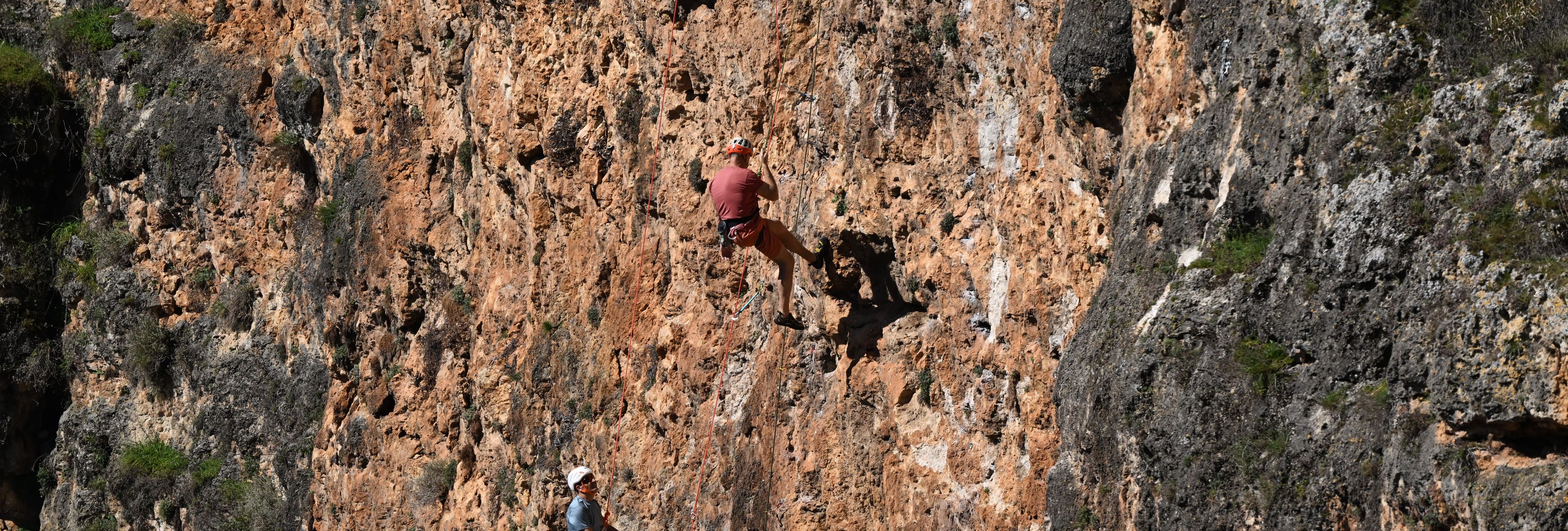
The Gear Gap That Kills Your First Outdoor Season
You have been climbing in the gym for two years. You have sent your first V6, maybe your first 5.11d on top rope. You think you are ready for the crag. You are not ready for the crag. Your rack is empty, your knowledge is theoretical, and your gear list is a google doc you copied from a forum post written by someone who has never actually led a climb outside. This article is not a shopping list. This is the actual breakdown of what you need, why you need it, and what you can safely skip until you have been climbing outside long enough to know better.
Outdoor climbing gear is not just gym equipment rated for sun exposure. It is the difference between managing risk and hoping nothing goes wrong. Your harness, your shoes, your rope, your protection, your helmet. Everything on your body and in your rack needs to be evaluated through one lens: can this item fail in a way that kills me, and if so, what is the margin of error. Gym climbing has sanitized risk management into a routine. Cragging will remind you that gravity still applies and that the rock does not care about your personal best. The gear you choose matters, and choosing it based on color or brand recognition instead of function will cost you money at best and safety at worst.
Your transition from gym climber to outdoor climber is going to be expensive because every piece of gear you buy is a decision informed by experience you do not yet have. You will replace your first harness within a year. You will throw away your first rope after two seasons because you did not know how to manage it properly. Your first pair of outdoor shoes will be wrong for your foot shape and you will buy the right pair six months later. That is fine. Every crag regular has been there. But you can avoid the worst mistakes by understanding what matters before you open your wallet.
Footwear: The First Decision That Affects Everything
Your gym shoes are comfortable. Your gym shoes are probably too soft and too flat for the demands of outdoor climbing. Most gym climbing happens on volumes and jugs. Your feet do not need to stand on edges because the wall is never steep enough to require it. Outdoor climbing will expose every weakness in your shoe choice because the rock will ask your feet to do things your gym climbing never demanded.
Outlet climbing gear for your feet starts with understanding that outdoor shoes need a harder heel cup, a stiffer sole, and more precise toe box geometry than your gym slippers. The specific model depends on your foot shape and your primary climbing style. If you are planning to climb on splitter cracks, you need a shoe that can fit in a narrow constriction and stay painful for an hour without your foot going numb. If you are planning to climb on faces and slabs, you need a shoe with a flat sole and excellent smearing surface that lets you trust your felt on nothing. These are different requirements. There is no single shoe that does both well.
Resole options matter in 2026 in a way they did not matter ten years ago. Most climbing shoe manufacturers now offer half-resole programs and repair services that extend the life of a quality shoe by two or three soles. Budget climbing shoes that are glued together with no attachment method for resoling are a false economy when you are climbing forty days a year. Buy once, resole twice, be done. A quality outdoor climbing shoe that costs twice as much and lasts three times as long is cheaper per session than the bargain bin pair you replace every six months.
Do not buy aggressive downturned shoes for slab and vertical face climbing. Do not buy flat slippers for crack climbing. Know your primary discipline before you buy, and buy slightly below your limit so you can wear them for three hours without wanting to take them off at the first comfortable stance. Your feet are your primary contact with the rock. Everything else is just letting you stay connected to them.
Ropes: What Your Gym Does Not Teach You
Gym ropes are always dry, always clean, always marked with a manufacture date, and always retired on schedule by gym staff who do not want liability. Your outdoor rope is dragged across rock, soaked in rain, stepped on, abraded by carabiners, and generally treated like a piece of gear rather than a lifeline. This is fine. Ropes are designed to handle this. But you need to understand what is happening to your rope so you can make good decisions about when to retire it.
Dry treatment is not optional for outdoor climbing gear if you climb anywhere with regular moisture. Standard ropes absorb water and become heavy, stiff, and harder to handle in wet conditions. A dry-treated rope sheds water and maintains its handling characteristics in rain, morning dew, and creek crossings. Some ropes are treated only on the sheath. Some are treated on both sheath and core. Fully dry-treated ropes cost more and last longer in wet conditions. In the Pacific Northwest, the desert Southwest during monsoon season, or any crag where the approach crosses a water feature, a non-dry rope is a liability you are accepting because you did not want to spend money on appropriate equipment.
Diameter affects everything. Thicker ropes are more durable and easier to handle for beginners. Thinner ropes have less drag on long routes and feel better on small diameter quickdraw carabiners. The standard for sport climbing in 2026 is somewhere between 9.4 and 9.8 millimeters for a single rope. Your gym probably uses 10.2 or 10.5 because they want the rope to last forever and they do not care about drag. If you are climbing routes with less than twenty meters of climbing and minimal wandering, a thinner rope will feel better and perform adequately. If you are climbing routes with 100 feet of rope out and bolts that wander, a thinner rope will save your shoulders and your belay device's sanity.
Retire your rope on schedule. Most manufacturers recommend retirement after three to five years of regular use, sooner if the rope has been subjected to a significant fall factor or visible sheath damage. Mark your rope with the purchase date. Log your major falls. A rope that has caught a ground-fall or a factor two impact has been damaged internally even if the sheath looks fine. The core fibers have compressed and will not perform the same way on subsequent falls. This is not alarmism. This is the actual engineering of dynamic rope systems. Your outdoor climbing gear is only as reliable as your willingness to retire it before it fails.
Protection: The Rack That Keeps You Alive
Sport climbing requires a draw belt, quickdraws, a belay device, a harness, and a helmet. Trad climbing requires all of that plus cams, nuts, slings, and the knowledge of where and how to place them. If you are starting on sport routes, your protection needs are simpler and your budget can be concentrated on fewer categories of gear. If you are moving toward traditional placements, your rack education needs to come before your rack purchase, because owning gear you do not know how to use is owning a false sense of security.
Quickdraws are not all the same. The gate type, the gate opening width, the carabiner shape, the dogbone length, and the stitched sling versus unsitched sling all affect how the draw handles and how it performs on different climbing contexts. Sport climbing draws are usually shorter than traditional draws because sport climbing routes tend to be steeper and more vertical. Longer draws reduce rope drag on wandering routes but add weight and bulk. Your first set of draws should be durable enough to take repeated falls without gate failure and stiff enough to stay organized on your harness.
Helmets are not optional. This is not a suggestion. Your outdoor climbing gear list does not have an asterisk next to the helmet line. Rockfall happens. Belay errors happen. The climber above you drops a biner or kicks a loose pebble. Your head hits the rock during a fall. Any of these scenarios results in a head injury if you are not wearing a helmet. Modern helmets weigh under 300 grams and ventilate well enough that wearing one in summer heat is uncomfortable but survivable. Wearing a cracked helmet is worse than wearing no helmet because cracked helmets do not protect reliably. Inspect your helmet regularly. Replace it after any impact, even if no damage is visible.
Belay devices need to be matched to your rope and your experience level. Tubular devices work well for beginners and for small diameter ropes. Plate devices with assisted-braking features reduce the chance of an uncontrolled descent if your partner falls while you are unprepared. The specific model matters less than the habit of using it correctly. Practice your belay technique until it is automatic. Your outdoor climbing gear will fail in ways that your technique compensates for, but your technique cannot compensate for a device used incorrectly.
The Accessories That Actually Matter
Chalk is not optional but the type matters less than you think. Block chalk dissolves slower than chalk dust and reduces environmental impact at popular crags where chalk buildup is visible and discouraged. Liquid chalk and chalk balls reduce airborne dust in windy conditions and preserve your supply in humid environments. The brand is irrelevant. The presence of chalk on your hands when you need it is the actual requirement. Buy a chalk bag that clips securely to your harness, resists sagging when you lean away from the wall, and does not spill chalk when you are rappelling.
Approach shoes bridge the gap between your climbing shoes and hiking boots on the walk to the crag. If your approach involves talus fields, scree slopes, or anything steeper than a gentle incline, do not climb it in your technical shoes. Your outdoor climbing gear setup needs a pair of shoes that protect your ankles and grip loose rock so you can save your climbing shoes for the route itself. Some climbers use trail running shoes for shorter approaches. Some use dedicated approach shoes with sticky rubber on the toe. Neither is wrong. Both are better than climbing in flat gym shoes on loose terrain.
Phone or camera for documentation is part of your standard kit in 2026. Not for social media, for route research, for safety communication, and for the honest documentation of your sends and your falls. Many outdoor climbing incidents are resolved faster when there is cell service and a way to communicate coordinates to rescue services. Your outdoor climbing gear setup should include a way to charge your phone or keep it warm in cold conditions, because a dead phone in a belay stance is a failure of preparation.
Your first season of outdoor climbing will teach you more about gear than three years of gym climbing. You will discover that your harness fits wrong when you are hanging belay for thirty minutes. You will learn that your shoes blow out on the third day of a weekend trip. You will figure out that your belay device handles awkwardly when your hands are cold. Every piece of gear you buy now is a learning experience. Buy functional gear from reputable manufacturers, learn what works for your body and your style, and replace things deliberately rather than in a panic when something fails at the crag.